

In modern heavy-duty piping systems-such as offshore oil drilling platforms, marine desalination architectures, and high-pressure chemical transmission grids-Weld Neck (WN) Pipe Flanges are standard choices for high-stress connections. Manufactured to strict international benchmarks including ASME B16.5 and EN 1092-1, these components feature a long, tapered hub that transfers structural stresses directly to the pipe. This geometry drastically reduces stress concentration at the base of the flange, making them well-suited for severe thermal cycles and explosive pressure ratings.
However, when sourcing components for high-risk environments, a critical question arises among procurement engineers: Are weld neck pipe flanges corrosion-resistant?
The engineering answer is conditional: Corrosion resistance is not an inherent trait of the flange design itself, but a direct product of metallurgical chemistry, post-forge heat treatments, and chemical passivation protocols. As an ISO 9001-certified global manufacturer, Chengji (cncjflange.com) breaks down the metallurgical mechanics that govern weld neck flange corrosion resistance.
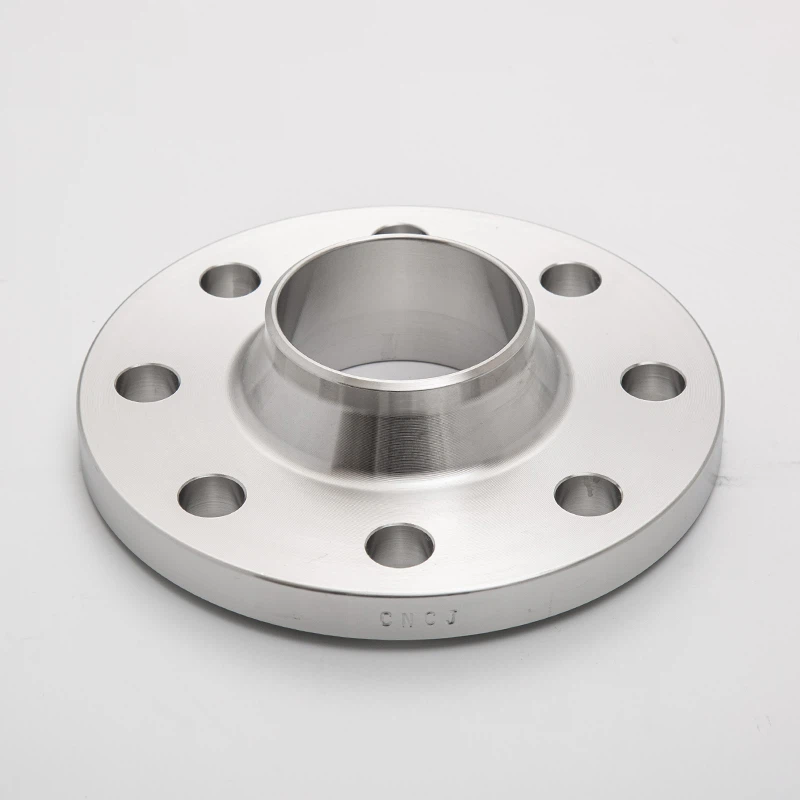
1. Metallurgical Chemistry: The Risk of Sensitization in the HAZ
The primary mechanism that compromises a weld neck flange's corrosion resistance occurs during its installation. Because weld neck flanges are butt-welded to adjacent piping, the material adjacent to the weld bead undergoes severe thermal cycles.
- The Chromium Carbide Precipitation Trap: When welding standard austenitic stainless steels like SUS304 or SUS316, heating the metal within the critical temperature zone of $450^\circ\text{C}$ to $850^\circ\text{C}$ causes carbon atoms to diffuse to the grain boundaries. This carbon binds with adjacent chromium to form chromium carbides ($Cr_{23}C_6$). This process depletes the localized chromium content below the critical $12\%$ threshold required for passivation, leading to intergranular corrosion within the Heat-Affected Zone (HAZ).
- The Low-Carbon (L-Grade) Solution: To permanently neutralize sensitization risks in aggressive chemical processing fluids, Chengji mandates the selection of dual-certified low-carbon alloys such as ASTM A182 F304L and F316L. By strictly limiting carbon concentrations to $\le 0.03\%$, carbide precipitation is structurally inhibited. This allows the chromium to remain distributed uniformly throughout the matrix, ensuring weld-joint integrity even in high-chloride marine environments.
2. Post-Forge Heat Treatments: Eliminating Stress Corrosion Cracking (SCC)
Corrosion acceleration is fundamentally tied to residual mechanical stresses introduced during the industrial forging process.
- Stress Corrosion Cracking (SCC) Vulnerability: Forged steel that is cooled unevenly develops latent tensile stress fields within its crystalline lattice. When exposed to hot chloride solutions or high-pressure steam, these internal stresses work in tandem with chemical oxidizers to cause sudden, transgranular micro-fissures known as Stress Corrosion Cracking (SCC).
- Full Solution Annealing Protocol: At Chengji, we eliminate this latent risk via strict thermal remediation. All forged austenitic stainless steel weld neck flanges undergo an intensive solution annealing process. Components are heated uniformly to a minimum temperature of $1040^\circ\text{C}$, completely dissolving any precipitated carbides back into the austenite matrix. This is followed by a rapid water quench to lock the homogenous solid solution in place, completely eliminating residual stresses and restoring baseline chemical passivity.

3. Surface Passivation and External Coating Technologies
The actual barrier protecting a steel flange from environmental decay is a microscopic oxide layer. Optimizing this boundary requires advanced surface treatments.
- Chemical Acid Pickling and Passivation: Following final CNC machining, every stainless weld neck flange produced by Chengji undergoes a dedicated nitric or citric acid chemical pickling bath. This process strips away any free surface iron introduced by industrial cutting tools, forcing the rapid, uniform reformation of a dense chromium oxide ($Cr_2O_3$) passive layer.
- Duplex Coatings for Carbon Steel Alloys: When high-tensile carbon steel (such as ASTM A105) is selected for non-corrosive media but deployed in high-humidity exterior environments, baseline metallurgy lacks protection. For these configurations, we apply high-build epoxy resins, hot-dip galvanization, or proprietary zinc-flake coatings to act as sacrificial barriers against external atmospheric oxidation.
4. Operational Alignment and System-Wide Single-Sourcing
A pipeline infrastructure grid functions as a unified mechanical assembly. If high-resistance weld neck flanges are paired with sub-standard companion fittings, galvanic differentials will accelerate corrosion right at the joint connections.
At Chengji, our production lines and material selection matrices are completely synchronized across our entire manufacturing facility. This ensures that when you source our high-passivity weld neck flanges to connect alongside our heavy-duty SS Plate Flange assemblies, pressure-rated industrial Blind Flange End structures, or high-flow Weld Tee setups, every component matches perfectly in chemical composition, raw heat numbers, and exact machining tolerances. This eliminates galvanic cross-contamination and is fully backed by EN 10204 3.1 Material Test Reports (MTRs).
5. Non-Destructive Testing (NDT) Quality Verification
Verifying corrosion resistance requires concrete data, not generic promises. Chengji validates every production run using strict NDT metrics:
| Testing Protocol | Target Failure Mechanism | Industrial Compliance Benchmark |
| ASTM A262 Practice E | Intergranular Corrosion Susceptibility | Mandatory for All Stainless Steel Batches |
| Positive Material Identification (PMI) | Alloy Chemistry & Molybdenum Verification | 100% Individual Component Verification |
| Dye Penetrant Inspection (DPI) | Surface Porosity & Micro-Crack Detection | ASME Section V Standards |
Conclusion: Source Fully Traceable Industrial Flanges
Weld neck pipe flanges are exceptionally corrosion-resistant, provided they are engineered with proper low-carbon metallurgy (such as F316L), subjected to full solution annealing, and passivated via professional acid pickling. Skimping on these hidden manufacturing steps to secure a lower initial price will inevitably lead to costly pipeline failures on-site.
Are you engineering a high-stakes pipeline grid or updating an industrial procurement list for an upcoming project? Contact the Chengji Technical Engineering Team Today to secure complete dimensional CAD profiles, raw material tracking data, and factory-direct project quotes.
Industrial References
ASME B16.5: Pipe Flanges and Flanged Fittings (NPS 1/2 Through NPS 24 Metric/Inch Standard).
ASTM A182 / A182M: Standard Specification for Forged or Rolled Alloy and Stainless Steel Pipe Flanges for High-Temperature Service.
EN 10204: Metallic Products - Types of Inspection Documents (Type 3.1 Traceability Standard).